
How to Budget for Road Construction Projects in Zimbabwe
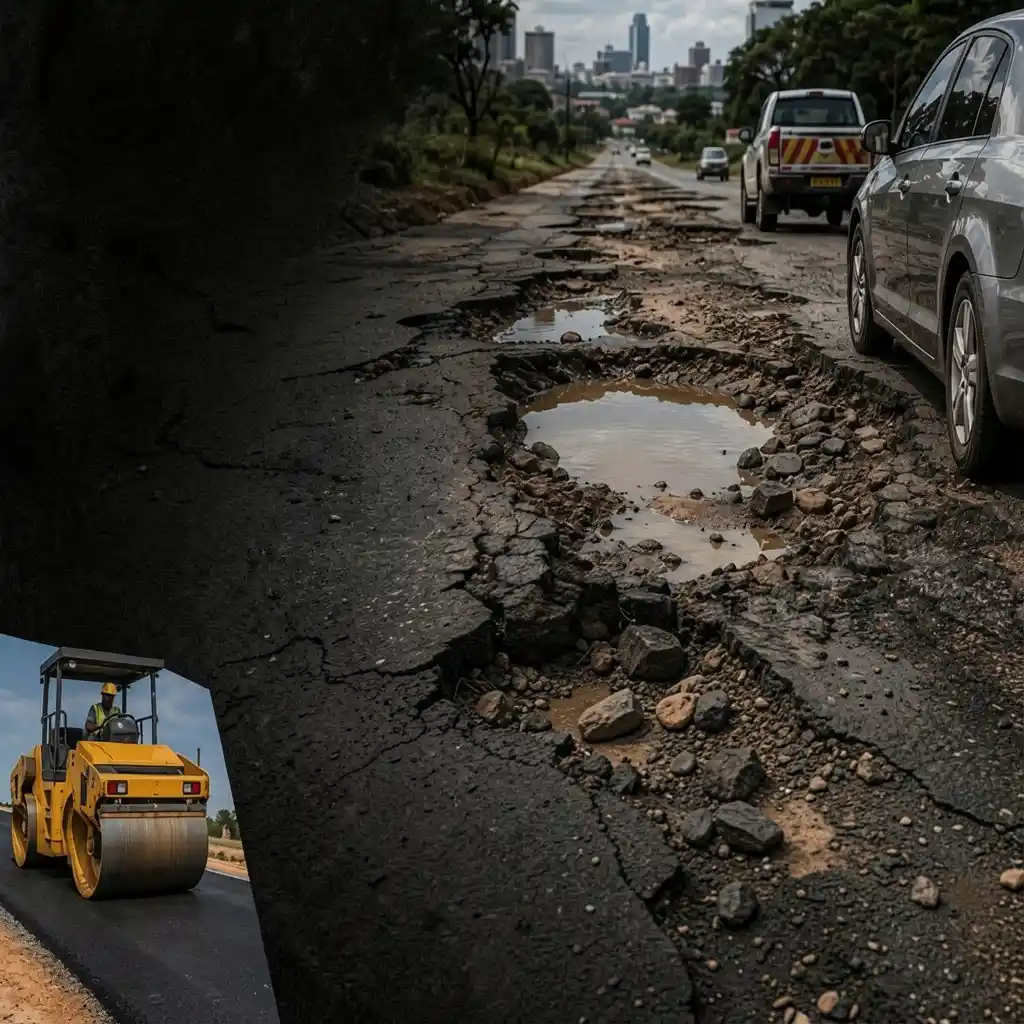
Poor road construction in Bulawayo and across Zimbabwe costs property owners, developers, and businesses far more than they realise. What looks like a minor saving at the start quickly becomes an expensive problem — one that compounds every rainy season. At Tusker Civils & Landscapes, we see the consequences of substandard road construction work every week. This post breaks down exactly what those consequences are, why they happen, and what proper road construction in Zimbabwe actually looks like.
Why Poor Road Construction Is So Costly in Zimbabwe
Zimbabwe’s climate is demanding. Bulawayo experiences intense summer rainfall, significant temperature swings, and expansive clay soils in many areas. These conditions punish a poorly built road fast. A road that lacks proper subgrade preparation, correct layerworks, or adequate drainage will begin to fail within one to two wet seasons — sometimes sooner.
The real cost is not just the repair bill. Vehicle damage absorbs money from your staff and visitors daily. Liability risk climbs on every estate or business that lets the problem sit. Then come the impressions — a potholed driveway signals neglect before a visitor even reaches your front door. Worst of all, full rehabilitation costs exponentially more than building correctly the first time.
The Most Common Causes of Road Failure
Most road failures in Zimbabwe come down to a handful of predictable mistakes. First, contractors skip or shortcut the subgrade assessment. They lay surfacing over weak, unstable ground without understanding what sits underneath. The result is a road that deflects under load and cracks quickly.
Second, rushed or inadequate compaction destroys long-term performance. Each layer of a road structure — subgrade, subbase, base, and wearing course — must reach a specific compaction standard before the next layer goes down. When contractors skip this step to save time, the road consolidates unevenly after opening to traffic, creating ruts and depressions almost immediately.
Third, poor drainage planning accelerates failure faster than almost any other factor. Water is the single greatest enemy of any road. When stormwater has no clear path away from the road structure, it infiltrates the base and subbase, saturates the material, and triggers rapid structural collapse. A road without proper kerbing, channels, and catch pits will not last — regardless of how well everything else was built.
What Correct Road Construction in Bulawayo Actually Involves
Building a road that lasts requires a disciplined, staged process. There are no shortcuts that do not come back to bite you later. Here is what proper roadworks in Bulawayo should look like from start to finish.
Step 1 — Subgrade Assessment and Preparation
Before any material goes down, the team must assess the in-situ soil. The bearing capacity of the subgrade determines the entire road structure above it. Weak soils — and Bulawayo has plenty — require either stabilisation or additional layerworks to compensate. Skipping this assessment and going straight to laying is one of the most expensive mistakes a developer can make.
Step 2 — Layerworks and Compaction
Once the team prepares the subgrade, the road structure builds up in layers. Each layer uses a specified material — typically G7 or G5 gravel for the subbase, crushed stone or stabilised material for the base — and a qualified crew must compact it to a specified density using the correct equipment. A light roller and guesswork will not cut it. Proper compaction equipment and testing are non-negotiable on every project we undertake.
Step 3 — Surfacing
The wearing course is what people see, but the structure beneath it determines how long the road lasts. That said, the correct specification and application of the wearing course still matters enormously. Thin, poorly mixed, or incorrectly applied surfacing will crack and delaminate quickly, allowing water to enter the structure below and accelerating failure from the top down.
For many private developments, estate roads, and access routes across Zimbabwe, a well-graded, properly compacted and drained gravel road offers a cost-effective and highly durable alternative to asphalt — provided the contractor builds it correctly with the right camber, material, and drainage.
Step 4 — Drainage and Kerbing
Every road Tusker constructs includes correctly specified kerbing, channels, and stormwater drainage — without exception. Water must move away from the road structure efficiently. According to the World Road Association (PIARC), inadequate drainage leads to premature road failure more often than any other single factor in developing-country contexts. That finding aligns exactly with what we observe on the ground in Bulawayo and across wider Zimbabwe.
The Rehabilitation Trap
Many property owners and developers come to us not with a new road project, but with a road that has already failed. Some had it built three years ago. Others watched it deteriorate within twelve months. In almost every case, the failure was predictable — and preventable.
Road rehabilitation costs significantly more than building correctly from the start. When a road fails structurally, the solution is not simply to resurface it. Tusker carries out a full condition assessment first. A failed sub-base requires us to remove the damaged material, repair the base, and then resurface. Laying a new wearing course over a broken base wastes money — the cracks reflect through within months, and you are back to square one.
Resurfacing a structurally failed road without addressing the base remains one of the most common and costly mistakes we see across Bulawayo. Do not let a contractor talk you into it.
Pothole Repairs — Do It Properly or Not at All
Potholes are more than a nuisance. They damage vehicles, create trip and fall hazards, expose your property to liability, and worsen exponentially if left untreated. A small pothole in January can become a 400mm-wide, 150mm-deep failure by March.
Cut-and-patch is the correct repair method — not cold mix tipped into the hole and compacted by foot. The crew cuts back the area around the pothole to sound material, addresses the failed base, and compacts a proper bituminous patch into place. Our pothole repair service in Bulawayo follows this method on every job. It costs a little more upfront and lasts years instead of weeks.
How This Connects to Your Broader Civil Infrastructure
Roads rarely exist in isolation on a development. They connect to paving, drainage structures, concrete works, and waterproofing — all of which affect each other’s performance and longevity. A failed road that allows water to pool adjacent to a building will eventually compromise the building’s foundation and waterproofing from the outside in.
Working with a single contractor who manages all civil works under one contract removes that coordination risk entirely. Tusker handles roadworks alongside concrete, paving, flooring, and waterproofing on the same development — ensuring every element is coordinated, correctly sequenced, and built to the same standard.
The South African National Roads Agency (SANRAL) publishes guidance on road design, layerworks standards, and drainage requirements that experienced civil contractors across the region apply directly to Zimbabwean conditions. We reference it regularly.
What to Look for When Hiring a Road Construction Contractor in Zimbabwe
Before appointing a road construction contractor, ask these questions. Does the team carry out a subgrade assessment before pricing? Do they specify compaction standards and test for compliance? Does their quote include drainage design as standard — or does it appear only as an add-on? Do they repair potholes using cut-and-patch, or do they use cold mix fill? Can they show you comparable completed projects nearby?
A “no” or “we’ll deal with it as we go” answer to any of the first four questions should send you looking elsewhere.
Tusker Civils & Landscapes has built its reputation in Bulawayo on doing this work correctly. Our teams work across the city’s suburbs — including Hillside, Khumalo, Famona, Burnside, and beyond — for residential developers, estate managers, commercial property owners, and industrial clients who want work done once and done right.
Get a Road Construction Quote in Bulawayo
Planning a new road? Dealing with a failing one? Need to address potholes before the next rainy season hits? Talk to us. Tusker Civils & Landscapes provides honest site assessments, clear itemised quotes, and road construction work built to last in Zimbabwe’s conditions.
Recent Posts:
Why Structural Steelwork Is the Future of Commercial Construction in Bulawayo
Custom Steel Gates in Zimbabwe: What to Expect from Design to Installation
Steel Fencing vs Brick Walls in Bulawayo — Security, Cost and Longevity Compared
5 Stunning Green Wall Installations That Transformed Zimbabwean Commercial Spaces