
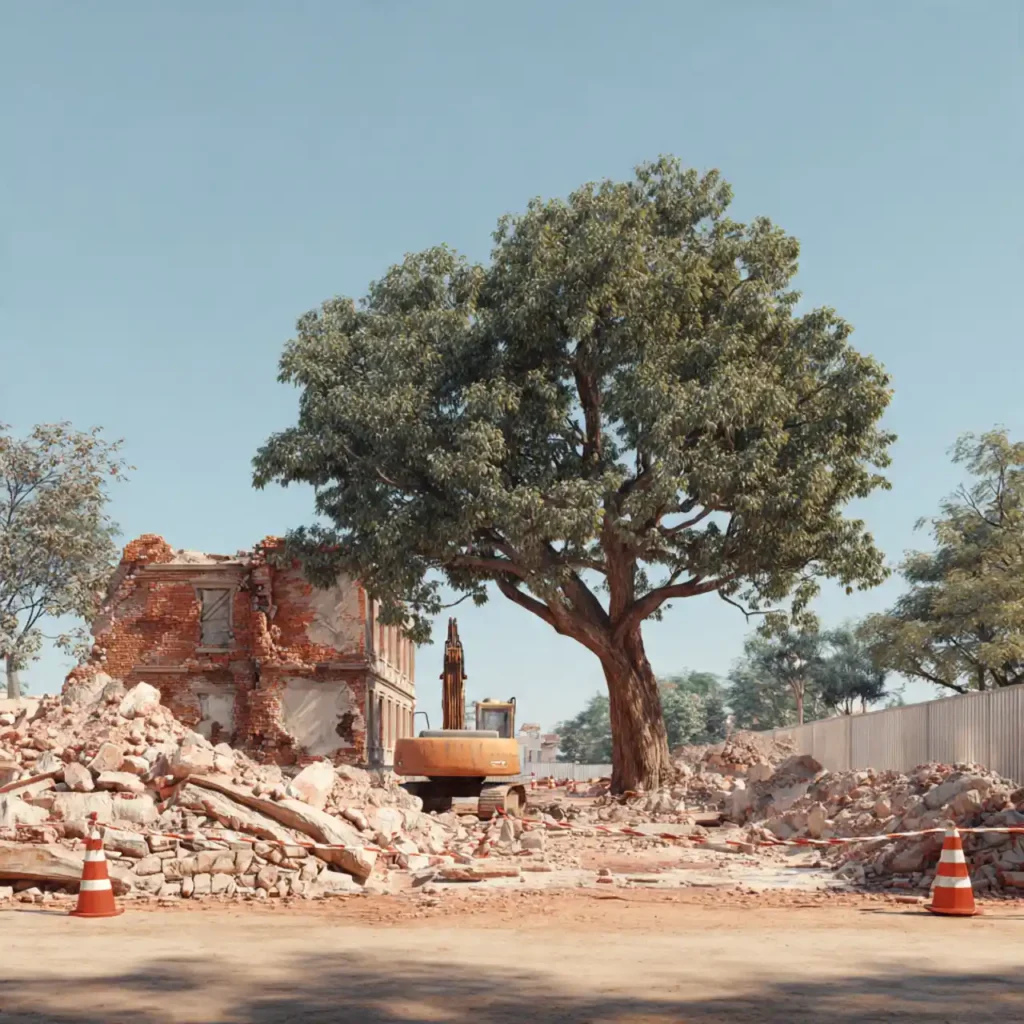
Demolition in Bulawayo: Legal Requirements Every Property Owner Should Know
You own property in Bulawayo, Zimbabwe. You want to tear down a structure — an old boundary wall, a residential home, or a commercial building. Before you do anything, know this: the law expects far more than simply swinging a hammer. Demolition in Zimbabwe falls under a web of regulations. Ignoring any part of that framework can lead to fines, work stoppages, or worse. At Tusker Civils & Landscapes, we guide property owners, developers, and estate managers through every legal step before a single wall comes down.
Why Demolition in Zimbabwe Is a Regulated Activity
Demolition isn’t a simple property maintenance task under Zimbabwean law. The Department of Physical Planning oversees all spatial and physical planning in Zimbabwe. It directs local authorities, who must follow the Regional, Town and Country Planning Act, the Urban Councils Act, and the Rural District Council Act.
In practical terms, the Bulawayo City Council holds the authority to approve, delay, or refuse your demolition project. Starting work without the right approvals puts you at serious legal risk. Building without a permit in Zimbabwe can result in fines, legal action, or demolition orders against your remaining structures.
So, before any contractor arrives on site, understand exactly what the law requires.
Step 1: Confirm You Need a Demolition Permit
Property owners often ask whether a permit is truly necessary for smaller projects. In most cases, the answer is yes.
Part V of the Regional Town and Country Planning Act defines development broadly. It covers not only new construction but also structural alterations and the depositing of waste on land. Demolition typically triggers that definition. Council approval therefore applies.
That said, certain minor works may fall under local by-law exemptions. The safest approach is to check with the Bulawayo City Council before proceeding. Alternatively, engage a contractor like Tusker Civils who already understands which projects need formal approval and which don’t.
Step 2: Apply to the Bulawayo City Council
Once you confirm your project requires a permit, submit a formal application to the local authority.
Your application must include a completed set of plans for the structure. A qualified draftsman or architect must prepare those plans. You also need the building permit application and a planning permit where applicable. For demolition specifically, your submission must identify the structure you plan to remove. It must also show its proximity to neighbouring properties and your plan for managing rubble and waste.
Approval timelines in Zimbabwe are not always fast. The city council can take up to ten months to approve or reject a development request. Factor that into your project schedule early. Doing so avoids costly delays later.
Step 3: Disconnect All Services Before Work Begins
This is a legal requirement — not just a safety tip. Zimbabwe’s Model Building By-laws are explicit on this point.
You must shut off and cap all gas, electricity, water, and sewer lines before demolition begins. Re-laying those supply lines beforehand is also a requirement where applicable. Additionally, workers must remove all glass from windows, doors, and roof-lights before any structural work starts.
Failing to disconnect services creates serious safety hazards. It also exposes you to liability if anything goes wrong on or adjacent to your property.
Step 4: Protect the Public and Neighbouring Properties
Zimbabwe’s building regulations place a clear duty of care on anyone carrying out demolition near public spaces or neighbouring structures.
Work within three metres of a street or public place triggers an additional requirement. The contractor must erect covered walkways along the entire affected boundary. The only exception applies if the local authority grants written exemption.
Furthermore, the local authority can restrict when your team carries out high-risk demolition operations. Where the work may endanger public safety, the council fixes the permitted hours in advance. The goal is to eliminate — or at least minimise — danger to the public.
This is precisely why choosing an experienced demolition contractor in Bulawayo matters. A professional team erects the correct site protection, manages noise and dust, and coordinates with the council where required. You don’t carry that burden alone.
Step 5: Address Hazardous Materials — Especially Asbestos
Older buildings in Bulawayo frequently contain asbestos-cement sheeting in roofs, ceilings, and external cladding. Disturbing asbestos without proper handling is both a health risk and a legal issue.
The Environmental Management Act requires contractors and developers to obtain an Environmental Impact Assessment (EIA) for certain construction projects. Environmental considerations must factor into all construction activities — and demolition is no exception. Where asbestos or other hazardous materials are present, specialist removal and disposal procedures must happen before any structural demolition begins.
At Tusker Civils, we conduct pre-demolition surveys to identify hazardous materials. Our team then manages their removal safely and legally as part of our standard process.
Step 6: Manage Rubble Disposal Responsibly
Where does the rubble go? Zimbabwean law doesn’t leave that to chance. Uncontrolled dumping of demolition waste is illegal. Proper disposal must align with Environmental Management Act provisions.
A responsible contractor loads, hauls, and disposes of all waste through approved channels. At Tusker Civils, rubble removal and site clearance form part of our demolition services in Bulawayo. Your site ends up clean and ready for the next phase — whether that’s new construction, paving, or landscaping.
What Happens After Demolition?
Once the site is cleared, the real opportunity begins. Tusker Civils offers a full range of civil construction services. Our teams move directly from demolition into concrete work, waterproofing, flooring, and paving. There’s no need to switch contractors, and your timeline stays tight.
Transforming a cleared residential plot? Our landscaping division is ready to install instant lawns, irrigation systems, or artificial grass that perform all year round in Zimbabwe’s climate.
Don’t Risk a Non-Compliant Demolition
The legal framework around demolition in Bulawayo exists to protect people — neighbours, passersby, and the workers on site. Consult your local council early. Factor permit fees and timelines into your budget. Keep all approvals and inspection reports on record. These steps are non-negotiable for any demolition project in Zimbabwe.
Working with a professional contractor removes most of the complexity. Tusker Civils handles the pre-demolition survey, advises on permitting, manages all hazardous materials, and leaves your site fully cleared and compliant.
Ready to Plan Your Demolition in Bulawayo?
Tusker Civils & Landscapes delivers professional, legally compliant demolition services across Bulawayo. We work with residential, commercial, and industrial clients. Our team brings the equipment, the expertise, and the compliance knowledge to get the job done safely and on schedule.
Recent Posts:
Instant Lawn vs Seeding — Which Makes More Sense for Bulawayo Homeowners?
Which Instant Lawn Grass Type Survives Best in Zimbabwe’s Climate?
Instant Lawn in Bulawayo — The Fastest Way to a Beautiful Garden in Zimbabwe
Real Grass vs Artificial Grass in Zimbabwe — Which Wins for Low Maintenance?