
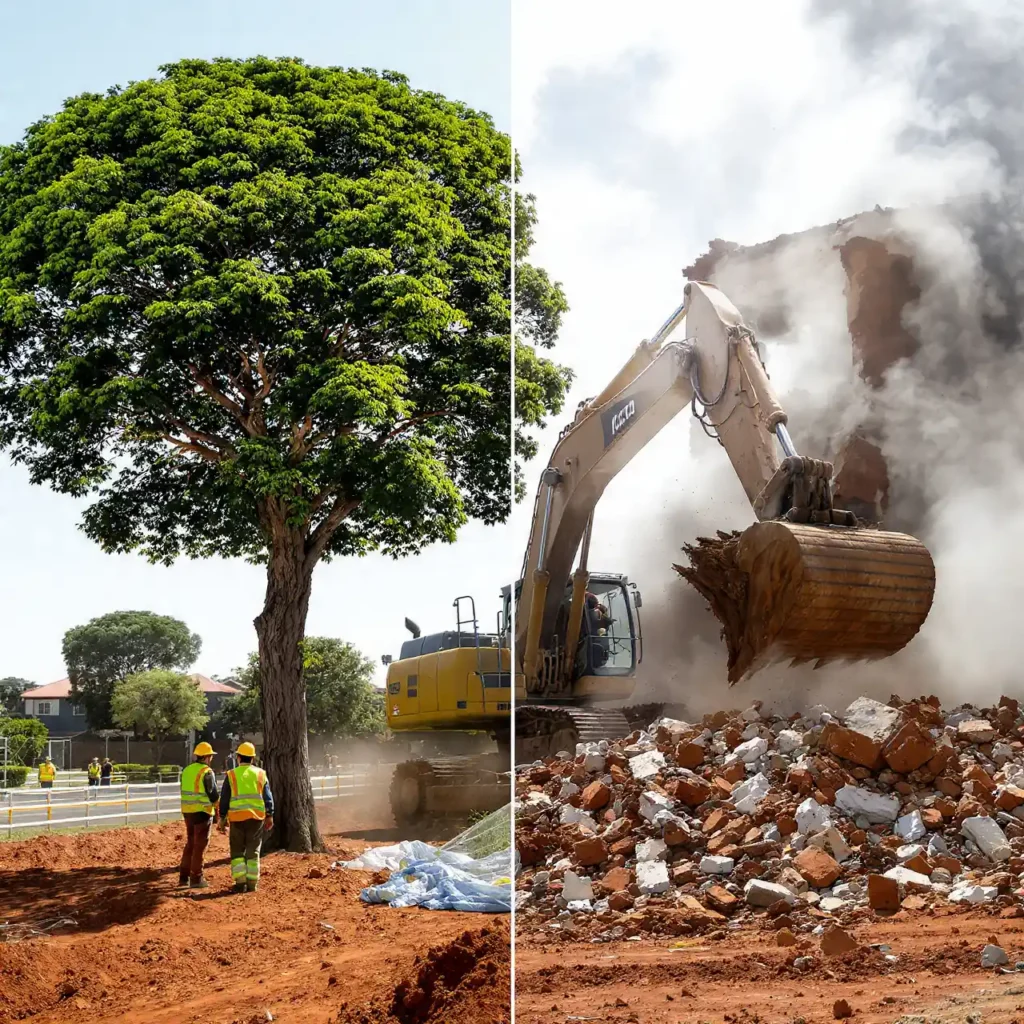
Why Professional Demolition Contractors Deliver Safer Results in Zimbabwe
When a building reaches the end of its life, demolition looks deceptively simple from the outside. Yet safe demolition in Zimbabwe demands expert planning, specialist equipment, and a team that genuinely knows what it is doing. In Bulawayo, property owners increasingly face a choice between professional demolition services and cheap, unqualified operators who cut corners. That choice can mean the difference between a clean, controlled project and a catastrophic accident.
At Tusker Civils & Landscapes, we have seen firsthand what cowboy contractors leave behind — collapsed retaining walls, hazardous material left on site, and damage to neighbouring properties. This post breaks down what responsible demolition looks like, why it matters, and what to demand from any contractor before a single wall comes down.
Why Demolition in Zimbabwe Is More Complex Than It Looks
Structural Hazards Are Not Always Visible
Older buildings across Bulawayo and Zimbabwe often contain hidden dangers. Asbestos-containing materials, corroded structural steel, undermined foundations, and compromised load-bearing walls are all common in properties built before the 1990s. A professional team identifies these risks before work begins. A cowboy contractor simply starts swinging.
Proper demolition begins with a thorough structural assessment. Engineers must evaluate how the building carries load and how removing one element will affect everything else. Without that assessment, a wall can fall outward instead of inward — directly onto a neighbouring structure, a worker, or a passing pedestrian.
Site Preparation Is Non-Negotiable
Before any physical work starts, professionals disconnect and cap all utilities — water, electricity, and gas where applicable. They also establish clearly marked exclusion zones around the work area. Furthermore, they remove salvageable materials such as timber, roofing sheets, and steel that can be reused or recycled responsibly.
Cowboy contractors skip these steps. They disconnect nothing, warn nobody, and protect nothing. The result is live cables under rubble, waterlogged foundations, and neighbours whose properties sustain damage that takes months — and significant money — to repair.
What Professional Demolition Practice Actually Looks Like
A Methodical, Sequence-Driven Approach
Professional demolition teams work in reverse construction order. They remove the roof first, then upper floors, then walls, then foundations — in a deliberate sequence that controls how and where material falls. This is not optional. It is the fundamental difference between a safe teardown and a dangerous collapse.
At Tusker Civils, our civil construction approach to demolition integrates this methodology on every project, whether it is a single residential outbuilding in Famona or a larger commercial structure in Bulawayo’s CBD.
Dust, Debris, and Noise Management
Demolition produces enormous quantities of dust, particularly in Zimbabwe’s dry winter months. Professional contractors wet down surfaces continuously to suppress airborne particles. They also erect hoarding and containment barriers to contain falling debris within the work zone.
Cowboy operators produce toxic dust clouds that drift across neighbouring properties, roadworks, and public spaces. Beyond the health risk, this exposes property owners to legal liability if neighbouring residents or businesses suffer harm as a result.
Waste Removal and Site Reinstatement
A professional demolition crew leaves the site clean and ready for the next phase of construction. Rubble gets sorted, hazardous materials get removed separately, and the ground gets cleared to the agreed level. Many sites then move directly into concrete work or paving — and a clean handover makes that transition seamless.
Cowboy contractors, by contrast, remove nothing they do not have to. They dump rubble on site, leave broken glass and rebar exposed, and disappear before the job is complete.
The Specific Risks of Hiring Unqualified Demolition Contractors in Zimbabwe
No Insurance, No Recourse
Unqualified contractors carry no professional indemnity or public liability insurance. Accordingly, when something goes wrong — and it often does — you carry the cost. Property damage, injury claims, and legal fees fall entirely on the property owner who hired the unqualified team.
Professional contractors carry insurance and take legal responsibility for the work they perform. That single factor alone should drive every decision.
Asbestos: A Particularly Dangerous Blind Spot
Zimbabwe’s construction stock includes a significant volume of asbestos-containing materials, particularly in roof sheeting and wall panels installed before the 1980s. According to Civil Engineer Magazine, proper pre-demolition assessment must identify asbestos and other hazardous materials before any structural work begins.
Cowboy contractors either do not recognise asbestos or deliberately ignore it. Breaking asbestos sheeting without containment releases fibres that cause mesothelioma — a fatal lung disease. This is not a minor oversight. It is a criminal risk to workers, neighbours, and future occupants of the site.
Structural Instability After Poor Demolition
Partial demolition done incorrectly destabilises what remains. The Institute of Demolition Engineers notes that uncontrolled partial demolition is one of the leading causes of unexpected structural collapse in construction environments. If you plan to build on the cleared site — whether adding steelworks, a new slab, or an extension — the foundation must be properly cleared and assessed first. A botched demolition creates a compromised base that undermines every construction phase that follows.
What to Ask Any Demolition Contractor in Bulawayo Before You Sign
Five Questions That Separate Professionals from Cowboys
You do not need to be an engineer to vet a demolition contractor. Ask these questions directly and pay close attention to the responses.
First, ask whether they conduct a pre-demolition structural assessment and who performs it. A professional will involve a qualified engineer or experienced site supervisor. A cowboy will give you a vague answer about “checking the walls.”
Second, ask how they handle asbestos identification and removal. Any serious contractor will reference a specific protocol. If the answer is casual or dismissive, walk away.
Third, ask for proof of public liability insurance. Request the certificate in writing. If they hesitate, that tells you everything.
Fourth, ask for a detailed waste management plan. Where does the rubble go? How do they handle hazardous materials separately? A professional has clear answers. A cowboy does not.
Finally, ask who supervises the work on site daily. Professionals operate with a designated, accountable site supervisor present throughout the project. Cowboys send unskilled labourers with no oversight.
Tusker Civils: Professional Demolition Services in Bulawayo
Tusker Civils & Landscapes delivers safe, structured, and professionally managed demolition services in Bulawayo to residential, commercial, and industrial clients across Zimbabwe. Our teams operate with proper site assessments, full utility disconnection procedures, controlled demolition sequences, waste management, and complete site clearance — giving you a clean slate for whatever comes next.
Whether your project involves a boundary wall in Hillside, a derelict outbuilding in Khumalo, or a larger commercial structure anywhere in Bulawayo, we bring the expertise and equipment to get the job done safely, legally, and on time.
Ready to Plan Your Demolition Project?
Do not gamble with your property, your neighbours, or your legal liability by hiring an unqualified contractor. Contact Tusker Civils & Landscapes today for a professional demolition assessment and competitive quote.
Recent Posts:
Planning a Demolition in Bulawayo Here’s Everything You Legally Need to Know
Instant Lawn vs Seeding — Which Makes More Sense for Bulawayo Homeowners?
Which Instant Lawn Grass Type Survives Best in Zimbabwe’s Climate?
Instant Lawn in Bulawayo — The Fastest Way to a Beautiful Garden in Zimbabwe