
What Every Bulawayo Property Owner Should Know About Asbestos Before Demolition
Every week in Bulawayo and across Zimbabwe, workers swing sledgehammers into old walls, strip corrugated roofs, and clear decades-old structures — often without any idea of what sits hidden inside those materials. Asbestos is one of the most dangerous building hazards in Zimbabwe, and most property owners and construction crews handle it as though it does not exist. At Tusker Civils & Landscapes, our demolition services in Bulawayo follow strict safety protocols precisely because we understand what is at stake when the wrong materials meet the wrong tools.
Why Asbestos Is Still a Major Problem in Zimbabwe
Zimbabwe has a long and complicated history with asbestos. The country was once a significant producer of chrysotile asbestos, and the mineral found its way into thousands of buildings constructed during the colonial and post-independence eras. Roofing sheets, ceiling tiles, pipe insulation, wall cladding, and floor compounds in older Zimbabwean structures frequently contain asbestos-based materials. Zimbabwe is not among the more than 65 countries that have banned asbestos, and the mineral continues to appear in some construction products today.
The health consequences are severe. According to the World Health Organisation, all six main forms of asbestos are classified as carcinogenic to humans. Exposure causes lung cancer, cancer of the larynx and ovaries, and mesothelioma — a fatal cancer of the linings of the chest and abdomen. Asbestosis, a chronic scarring of the lung tissue, is another serious outcome. Symptoms frequently take 20 to 30 years to appear, which means a worker exposed on site today may not develop disease until well into retirement.
The problem runs deeper than individual workplaces. A 2024 study published by Springer Nature found that asbestos in Zimbabwe’s construction and demolition waste sector poses physical, chemical, and biological hazards, and that the existing regulatory frameworks require much stronger enforcement to protect workers and surrounding communities.
The Specific Risk During Demolition
Asbestos is relatively stable when it remains undisturbed inside a structure. The danger begins the moment someone starts breaking, cutting, or sanding asbestos-containing materials. Demolition disturbs those materials violently. Tiny fibres become airborne and invisible to the naked eye. Workers and bystanders inhale them without knowing it, and the fibres lodge deep in the lungs where they remain permanently.
In Bulawayo and other Zimbabwean cities, many buildings erected before 1990 carry asbestos roofing and ceiling board as standard construction. Older industrial premises, warehouses, schools, and even residential homes frequently contain asbestos materials. Without a pre-demolition asbestos survey, any crew breaking those structures releases hazardous fibres into the air around workers, neighbours, and passersby.
Furthermore, the National Cancer Institute confirms that smokers who face asbestos exposure carry a lung cancer risk that exceeds the combined individual risks from smoking and asbestos separately — a compounding effect that makes construction sites with poor safety controls particularly dangerous.
What a Responsible Demolition Process Looks Like
Pre-Demolition Survey and Material Identification
Before any structure comes down, a responsible contractor identifies whether asbestos-containing materials are present. This involves a physical inspection of the building, sampling of suspected materials, and laboratory testing where necessary. Tusker Civils & Landscapes treats every older structure in Zimbabwe as potentially containing hazardous materials until a survey rules it out. This step alone separates professional demolition from dangerous guesswork.
Safe Removal Before Demolition Begins
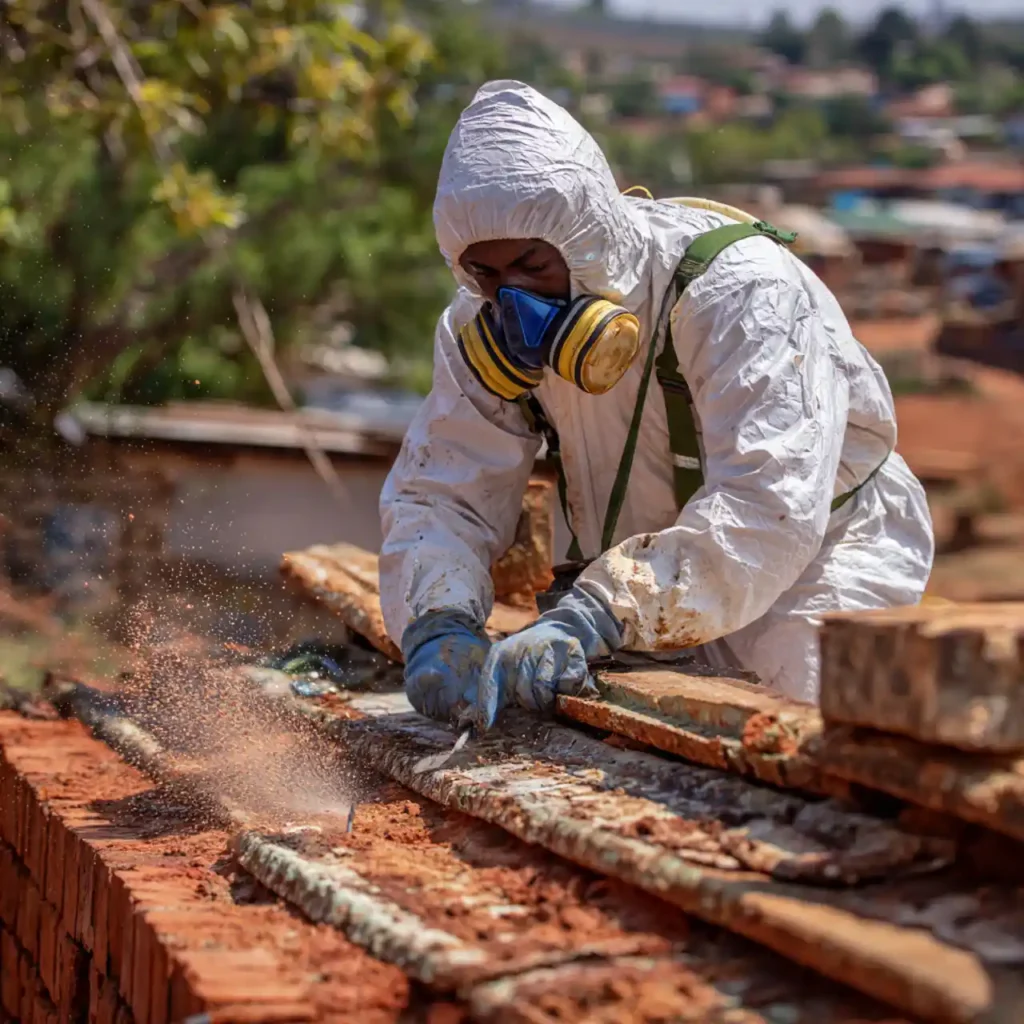
Asbestos removal must happen before any structural demolition starts — not during and not after. Qualified operatives wet the material to suppress dust, remove it carefully without breaking it unnecessarily, and seal it in clearly labelled, double-lined bags for disposal. No power tools go near asbestos sheeting. Workers wear appropriate respiratory protection throughout the process.
Site Containment and Waste Disposal
After removal, the site needs careful containment to prevent residual fibres from spreading. Waste disposal of asbestos materials requires a licensed disposal facility. Our civil construction team manages each of these stages under a single contract, so nothing falls between the cracks of multiple subcontractors with different standards.
Why DIY Demolition Is Particularly Dangerous in Zimbabwe
In Bulawayo and other Zimbabwean cities, it is common to see property owners hire casual labour to demolish old outbuildings, staff quarters, or storage sheds. The price is low, but the true cost often surfaces years later. Casual crews rarely conduct any survey, never test for asbestos, and typically break roofing sheets by hand or with blunt tools — exactly the actions that release the highest concentrations of airborne fibres.
Owners also face legal exposure. Zimbabwe’s Hazardous Substances and Articles Act places responsibility on those who handle, transport, and dispose of hazardous materials. Hiring unqualified crews to demolish an asbestos-containing structure does not transfer that liability — it amplifies it. A professional contractor with documented procedures provides a clear paper trail that protects the property owner as much as the workers.
What Comes After Demolition
Safe demolition is only the beginning. Once a site is clear, the next steps frequently involve paving services, new floor construction, or waterproofing for the replacement structure. Tusker Civils & Landscapes handles all of these disciplines under one contract, which means the site transitions from demolition to construction without delays, without multiple quotations, and without the coordination problems that come from using separate contractors for each trade.
Property developers in Bulawayo who plan to rebuild after demolition benefit significantly from this single-contractor approach. Ground preparation, base compaction, slab construction, and surface finishing all connect directly to the demolition phase when one team manages the entire project.
The Bigger Picture for Bulawayo and Zimbabwe
Bulawayo’s built environment contains a substantial stock of pre-1990 structures. As the city redevelops — converting old industrial land, upgrading commercial premises, and replacing deteriorating residential stock — the volume of demolition work will only increase. That makes proper asbestos management not a niche concern but a mainstream civil construction responsibility.
Zimbabwe’s public health system currently lacks the specialist capacity to diagnose many asbestos-related diseases accurately. Prevention is therefore the only reliable strategy. Every demolition contractor in Bulawayo who skips the survey, rushes the removal, or hands asbestos waste to an unlicensed dumper adds to a health burden that falls on workers, families, and communities for decades.
At Tusker Civils & Landscapes, we believe that professional standards in demolition protect people — not just property. Our approach reflects the same commitment to quality workmanship that runs through every service we offer, from demolition through to landscaping.
Ready to Plan a Safe Demolition in Bulawayo?
If you own an older property in Bulawayo or anywhere in Zimbabwe and need demolition carried out safely, correctly, and in full compliance with hazardous materials requirements, contact Tusker Civils & Landscapes today.
Recent Posts:
Partial vs Full Demolition — Which Option Is Right for Your Bulawayo Property?
How Much Does Building Demolition Cost in Bulawayo in 2026?
Stamped and Decorative Concrete — Can It Work in Bulawayo’s Heat?
Why Concrete Quality in Zimbabwe Varies So Much — And How to Ensure You Get the Best