
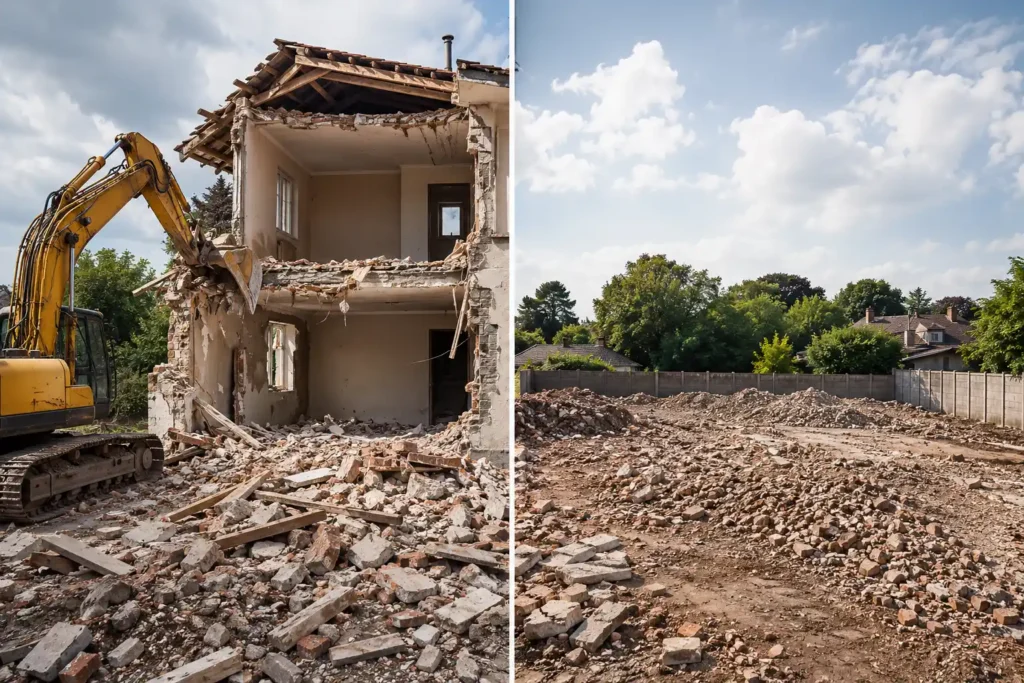
Choosing Between Partial and Full Demolition for Your Bulawayo Property
When a structure on your Zimbabwe property reaches the end of its useful life, or when you need to make way for something new, demolition becomes the next logical step. But not all demolition jobs look the same. At Tusker Civils & Landscapes, Bulawayo’s trusted civil construction specialists, we help property owners make the right call every time — starting with one of the most important decisions on any project: partial demolition or full demolition?
Understanding the difference saves you time, money, and costly mistakes down the line.
What Is Partial Demolition?
Partial demolition, sometimes called selective demolition or strip-out, involves removing only a specific section of a structure. The rest of the building stays intact and structurally sound.
Contractors use this approach when the property owner wants to renovate, extend, or reconfigure an existing building rather than clear the entire site. Think of removing an old servants’ quarters at the back of a Bulawayo home, breaking out a concrete wall to open up a floor plan, or stripping out a damaged roof section before rebuilding it.
Partial demolition demands a higher level of precision. Workers must protect surrounding structures, retain load-bearing elements, and manage debris carefully to avoid damaging what stays behind. Done correctly, it opens up significant renovation possibilities without the cost and disruption of a full knockdown.
What Is Full Demolition?
Full demolition means the complete removal of a structure down to ground level — and in many cases, the clearance of foundations and below-ground elements as well.
Property owners in Zimbabwe typically choose full demolition when a building is structurally compromised, when the land value outweighs the existing structure, or when a completely new design makes keeping any part of the old building impractical. Bulawayo developers clearing sites for new residential or commercial construction almost always go the full demolition route.
After full demolition, the cleared site undergoes preparation for new construction — grading, levelling, and in many cases new flooring and slab work from the ground up.
Key Factors That Influence Your Decision
Structural Condition of the Building
Start here. Have a qualified civil contractor assess the structural integrity of the existing building before committing to either route.
If load-bearing walls, the roof structure, or the foundations are severely compromised, full demolition is usually safer and more cost-effective than attempting a selective strip-out. Trying to retain a structurally weak structure during partial demolition creates unnecessary risk on site.
On the other hand, if the main structure is solid and only specific elements need removal, partial demolition protects your investment in what already stands.
Your Development Goals
Think carefully about what you want the finished property to look like. If your plans call for a completely new layout, new materials, and a fresh aesthetic, full demolition often makes more sense. Starting clean gives you total design freedom.
However, if you are extending an existing home, converting a garage, or reconfiguring interior spaces, partial demolition preserves the bones of the structure and significantly reduces rebuild costs. Many Bulawayo homeowners undergoing renovations opt for partial demolition precisely for this reason.
Budget and Timeline
Full demolition typically involves more heavy machinery, more labour hours, and more debris removal — all of which affect cost. However, it also eliminates the precision work and protective measures that make partial demolition labour-intensive in its own right.
Discuss your timeline and budget openly with your contractor. At Tusker Civils, we assess both options honestly and recommend the approach that delivers the best outcome for your specific situation. Once demolition is complete, we can move directly into related civil works such as paving or waterproofing, keeping your project under a single, dependable contractor.
Site Access and Neighbouring Structures
Site access plays a bigger role in this decision than many property owners expect. Full demolition with heavy equipment requires adequate clearance for machinery. In tighter Bulawayo residential areas, this can be a constraint.
Partial demolition on properties with shared walls or neighbouring structures demands especially careful planning. Your contractor must protect adjacent buildings throughout the process. This is standard practice for Tusker Civils’ demolition teams, who carry out thorough site assessments before any work begins.
When Partial Demolition Makes Sense in Zimbabwe
Partial demolition suits your project when:
The existing structure retains significant value and sound construction. You are renovating, extending, or reconfiguring rather than rebuilding from scratch. Budget constraints make full demolition and a complete rebuild impractical. Only specific elements — a wall, a roof section, a boundary structure — need to come down.
Many older Bulawayo properties fall into this category. They have strong brickwork and solid foundations but carry outdated layouts or damaged additions. Selective demolition lets owners modernise without starting over entirely.
When Full Demolition Is the Better Call
Full demolition is the right choice when the building is beyond economic repair, when your new design bears no resemblance to what currently stands, or when you need a completely clear site for a new development.
Developers, commercial clients, and estate managers in Zimbabwe frequently choose full demolition for sites where the new build requires fresh foundations, new drainage, and a fully reconfigured footprint. Following full demolition, Tusker Civils’ teams can manage the entire civil programme — from irrigation systems and landscaping through to paving and structural work — under one contract.
It is also worth noting that full demolition, when managed by an experienced team, can be faster than a complex partial strip-out. Speed matters when project timelines are tight.
Safety and Compliance in Zimbabwe Demolition Projects
Regardless of which route you choose, demolition carries real risks. Dust, structural instability, underground services, and debris management all require professional handling. The Institute of Demolition Engineers outlines international standards for demolition practice that responsible contractors align their work with — and Tusker Civils operates to those same principles of safety, site assessment, and controlled methodology.
Before any demolition begins, Tusker Civils conducts a thorough site inspection, identifies underground services, and develops a method statement for the job. We follow established industry guidance on controlled demolition to protect workers, neighbours, and the broader site.
For further technical context on demolition safety standards and best practice, the Chartered Institute of Building (CIOB) provides globally recognised frameworks that underscore why professional contractor selection matters.
Why Choose Tusker Civils for Demolition in Bulawayo?
Tusker Civils & Landscapes brings the equipment, the experience, and the local knowledge to handle both partial and full demolition across Bulawayo and the wider Zimbabwe region. We understand local site conditions, we know Bulawayo’s built environment, and we carry the expertise to manage demolition safely and efficiently — whether you are clearing a single outbuilding or a full commercial structure.
Moreover, because Tusker handles civil construction and landscaping under one roof, your property does not sit idle once demolition is complete. Our teams move directly into the next phase — whether that means new flooring, paving, waterproofing, or a full landscape transformation. You deal with one contractor, one point of contact, and one team committed to your project from start to finish.
Explore our full range of civil and landscaping services to see everything Tusker brings to your project.
Ready to Plan Your Demolition Project in Zimbabwe?
Whether you need a selective strip-out or a full site clearance, Tusker Civils & Landscapes is ready to help. Get in touch today to discuss your project, arrange a site visit, and receive a detailed quote.
Recent Posts:
How Much Does Building Demolition Cost in Bulawayo in 2026?
Stamped and Decorative Concrete — Can It Work in Bulawayo’s Heat?
Why Concrete Quality in Zimbabwe Varies So Much — And How to Ensure You Get the Best
Polished Concrete Floors in Bulawayo — The Trend Taking Over Modern Homes