
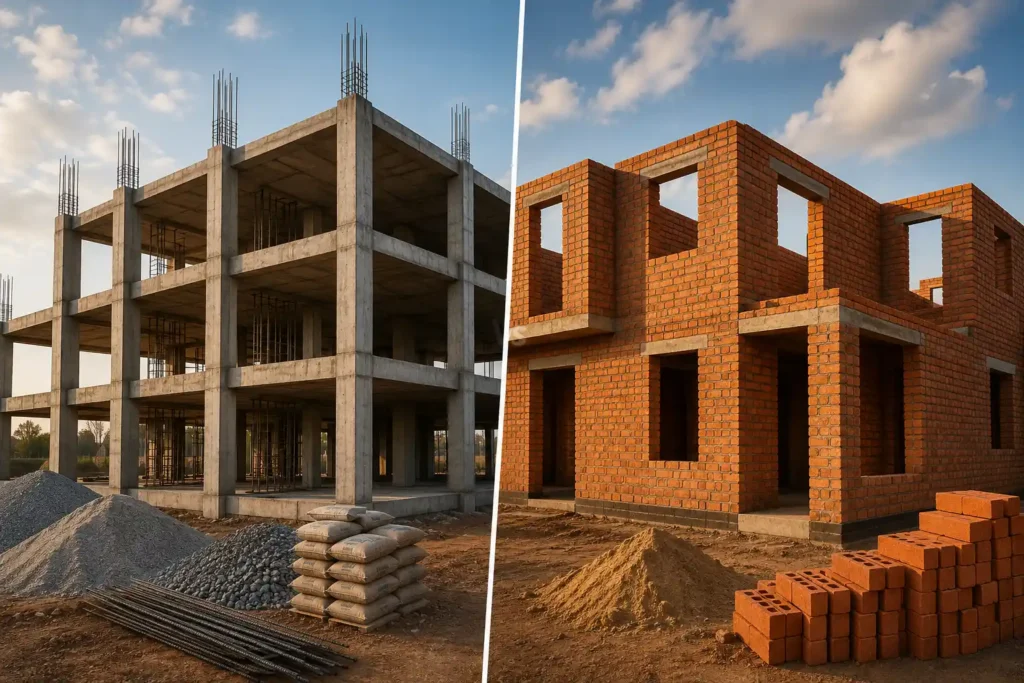
What’s the Better Choice for Builders and Homeowners?
In Bulawayo, Zimbabwe, construction choices directly affect cost, durability, and long-term maintenance. At Tusker Civils and Landscapes, we often guide clients through one key decision: should you build with concrete or brick? In many projects across Bulawayo and Zimbabwe, this choice determines structural strength, project timeline, and overall value for money.
This article breaks down both materials in real terms. It focuses on strength, cost efficiency, climate performance, and long-term durability. By the end, you will understand which option fits your project best.
Understanding Concrete and Brick Construction in Zimbabwe
Concrete construction uses a mix of cement, sand, stone, and water to form structural elements such as slabs, columns, beams, and foundations. Brick construction relies on fired clay or cement bricks laid in mortar to form walls and structural enclosures.
In Zimbabwe, both methods appear widely in residential, commercial, and industrial builds. However, their performance differs significantly depending on soil conditions, weather exposure, and building design.
At Tusker Civils, we apply both systems through our concrete construction services in Bulawayo and integrated building solutions. We choose the method based on structural demand, not preference.
Strength Comparison: Concrete vs Brick
Concrete delivers higher compressive strength than brick. It handles heavy loads, large spans, and multi-storey structures with ease. That makes it ideal for foundations, columns, slabs, and industrial buildings.
Brick performs well in walling applications but depends heavily on mortar quality and workmanship. It handles compression but struggles under extreme load or movement.
In practical terms, concrete offers greater structural stability in Bulawayo’s variable soil conditions and seasonal rains. Brick structures often require additional reinforcement to match similar strength levels.
For heavy-duty projects, we often combine both systems. Concrete forms the skeleton. Brick completes the enclosure.
You can see how we apply structural systems in real projects through our paving and hardscaping work in Bulawayo, where load-bearing strength and surface durability matter most.
Cost Comparison: Which Option Saves More Money?
Brick construction usually costs less upfront. Materials are cheaper, and labour requirements are more flexible. This makes brick attractive for smaller residential projects in Zimbabwe.
Concrete costs more at the start. It requires formwork, steel reinforcement, and skilled labour. However, it reduces long-term repair costs.
Over time, concrete often proves more cost-effective. It resists cracking, water damage, and structural movement better than brick. This reduces maintenance expenses significantly.
At Tusker Civils, we always evaluate lifecycle cost, not just initial price. This approach helps clients avoid hidden future repairs.
For example, when we handle waterproofing projects in Bulawayo, we often find brick structures require more frequent treatment due to moisture penetration.
Durability in Zimbabwe’s Climate Conditions
Zimbabwe’s climate places real stress on buildings. High heat, seasonal rainfall, and occasional soil movement affect material performance.
Concrete performs well under these conditions. It resists moisture and maintains structural integrity over decades. When properly cured, it withstands both heat expansion and water exposure.
Brick absorbs more moisture. Over time, this can lead to cracking, erosion, and structural weakening if not properly maintained.
This is why many modern developments in Bulawayo now use reinforced concrete as the primary structure, especially for commercial and industrial buildings.
For outdoor environments, we also integrate durable finishes through landscaping and irrigation solutions in Bulawayo to protect surrounding structures from water damage and soil erosion.
Construction Speed and Project Efficiency
Concrete construction often moves faster in large-scale projects. Once formwork and reinforcement are in place, pouring and curing can progress quickly across multiple sections.
Brick construction takes longer because each unit requires manual laying and alignment. Weather conditions can also slow progress, especially during rainy periods.
In Zimbabwe, time delays often increase labour costs. Therefore, faster structural systems can improve overall project efficiency.
Tusker Civils streamlines both approaches through coordinated planning. In many cases, we combine demolition, groundwork, and construction under one workflow using our demolition services in Bulawayo to prepare sites efficiently before building begins.
Maintenance and Long-Term Performance
Concrete structures require less ongoing maintenance. They resist pests, water ingress, and surface degradation. When properly reinforced, they remain stable for decades.
Brick structures need more frequent inspection. Mortar joints weaken over time, especially under heavy rainfall or shifting soil conditions.
In residential settings, maintenance costs often influence long-term satisfaction more than initial build cost.
For outdoor upgrades, many property owners later invest in surface improvements such as instant lawns in Bulawayo or artificial grass installations to stabilise soil around brick structures and reduce erosion impact.
Environmental and Sustainability Considerations
Concrete production uses more energy and generates higher carbon emissions. However, its long lifespan offsets some environmental impact through reduced rebuilding needs.
Brick production uses natural clay and simpler firing processes but still contributes to energy consumption. Transport and replacement cycles also affect environmental performance.
Globally, organisations such as the International Organization for Standardization (ISO) promote sustainable building standards that encourage lifecycle-based construction decisions rather than material preference alone.
Similarly, construction sustainability guidelines from sources like Engineering News Online highlight the importance of material efficiency and structural longevity in modern African infrastructure development.
At Tusker Civils, we consider sustainability in every project. We design structures that balance durability with resource efficiency.
When to Choose Concrete or Brick in Bulawayo
Concrete works best for foundations, commercial buildings, multi-storey structures, and high-load applications. It delivers strength, durability, and long-term cost efficiency.
Brick works best for boundary walls, residential infill walls, and decorative structures. It offers flexibility and lower initial costs.
In many Bulawayo construction projects, the best solution combines both materials. Concrete provides strength. Brick provides structure and finish.
We often integrate both systems into a single build to maximise performance and cost control.
How Tusker Civils Helps You Make the Right Choice
At Tusker Civils and Landscapes, we do not apply a one-size-fits-all approach. We assess soil conditions, building purpose, budget, and long-term use before recommending materials.
Our services include full construction preparation, structural works, and finishing solutions. From groundwork to final landscaping, we manage the entire process.
We also support clients through related services such as concrete works in Bulawayo, paving installations, and waterproofing systems to ensure complete structural performance.
Final Verdict: Which Is Stronger and More Cost Effective?
Concrete is stronger. It performs better under load and lasts longer in harsh conditions.
Brick is cheaper upfront. It suits smaller projects and non-structural applications.
However, the most cost-effective solution depends on the full lifecycle of the building, not just initial construction cost.
In Bulawayo, Zimbabwe, the smartest developments often combine both materials under expert guidance.
Build Smart with Tusker Civils and Landscapes
If you are planning a construction project in Bulawayo or anywhere in Zimbabwe, Tusker Civils and Landscapes is ready to help you choose the right structure from the start.
We handle everything from site preparation to final finishes with professional precision and local expertise.
Recent Posts:
How to Choose the Right Floor Tiles for Zimbabwe’s Climate and Lifestyle
Epoxy Flooring in Zimbabwe — Why Industrial and Commercial Properties Are Switching
The Best Flooring Options for Bulawayo Homes in 2026 — Tiles, Epoxy, Screed Compared
Site Clearance Before Construction in Zimbabwe — Why It’s More Complex Than You Think