
DIY Damproofing Tips for Rising Damp
Rising damp is one of the most destructive and frequently misunderstood building problems affecting homes and commercial properties across Bulawayo. Have you noticed a dark stain creeping up your interior walls? Do you see white powdery deposits at skirting board level, peeling paint near the base of your walls, or a persistent musty smell in your rooms? If so, you are almost certainly dealing with rising damp. Left untreated, it weakens plaster, rots timber frames, and damages decorative finishes. Over time, it also compromises the structural integrity of the wall itself. The good news: Bulawayo homeowners can take meaningful action before the problem escalates. This guide walks you through exactly how to do it.
What Causes Rising Damp in Bulawayo Homes?
Groundwater rises through the porous masonry of your foundations and lower walls through a process called capillary action. Think of it like a sponge drawing moisture upward — the finer the pores in the brick or mortar, the higher the water travels. Most Bulawayo properties sit on clay-heavy or expansive soils that retain significant moisture. Saturation levels climb during the rainy season. Many older homes in suburbs such as Suburbs, Hillside, Burnside, and Matsheumhlope lack an adequate damp-proof course (DPC). Builders finished them decades ago, and the DPC has since cracked, or raised garden soil and paving now bridge it. Even newer builds can develop rising damp if installers fitted the DPC incorrectly, or if ground levels have since risen above it.
Understanding the root cause matters before you reach for a product. Rising damp is a ground-level moisture problem. It behaves very differently from penetrating damp, which comes through walls horizontally from rain, or condensation damp, which forms on cold interior surfaces. Treating the wrong type of damp with the wrong product wastes money and leaves the problem intact.
Step One: Diagnose Before You Treat
Before spending a cent on treatment, confirm that you are dealing with rising damp and not one of its lookalikes. Take a piece of plastic sheeting or aluminium foil and tape it flat against the damp wall. Seal all four edges and leave it for 24 to 48 hours. If moisture appears on the side of the plastic facing the wall, the damp is coming from within the wall. This points to rising damp or moisture trapped in the masonry. If moisture forms on the room-facing side of the plastic instead, you are likely dealing with condensation. For a more authoritative breakdown of how to diagnose damp type correctly, check the Property Care Association’s guide to rising damp — it remains one of the most reliable free resources available.
Step Two: Address External Drainage and Ground Levels First
No internal treatment will hold unless you manage the external moisture source first. Walk around the affected wall on the outside. Check that ground levels, paving, or garden beds have not risen above the DPC line. In older Bulawayo builds, this line is typically a thin horizontal joint 150mm above the finished floor level. If soil has banked up against the wall, excavate it back down to at least 150mm below the DPC. Make sure gutters above stay clean and functional, and that downpipes discharge water well away from the foundation. Install a channel drain or French drain along the base of the affected wall if runoff consistently pools there during rain. Sika’s technical guidance on damp-proofing systems explains well how surface water management underpins every other treatment method.
Step Three: Apply a Chemical Damp-Proof Course Injection
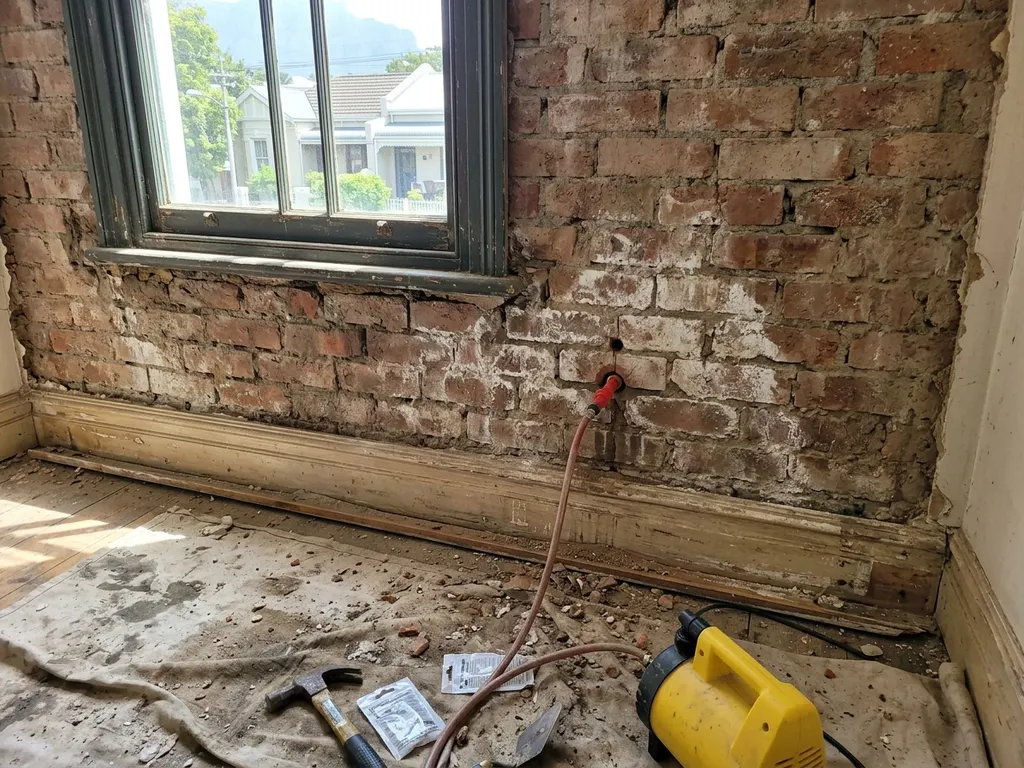
For existing walls without a functioning DPC, the most effective DIY repair is a chemical DPC injection. This involves drilling a horizontal row of holes at 120mm intervals along the mortar course, just above floor level. You then inject a silane or siloxane-based water-repellent fluid into the holes. The fluid diffuses through the masonry and cures to form a hydrophobic barrier that prevents further upward capillary movement. You can find kits at building material suppliers in Bulawayo and through regional distributors such as Damp sure, whose rising damp treatment system contractors widely use across southern Africa.
Drill at a slight downward angle of around 45 degrees to let the fluid flow into the wall by gravity. Use the correct nozzle to ensure even distribution. Work methodically from one end of the wall to the other. Allow the full curing time the product specifies — typically 24 to 48 hours — before replastering. For walls thicker than 280mm, drill from both sides. AfriSam’s technical document on waterproofing and rising damp provides excellent guidance on injection depths and mortar course selection for different wall constructions.
Step Four: Hack Off and Replace Contaminated Plaster
Rising damp deposits salts into the plaster as moisture evaporates, and these salts remain hygroscopic. This means they continue to attract moisture from the air even after you seal the damp source. This is why applying fresh paint or a membrane coat over old damp plaster always fails within months. You must physically remove the contaminated plaster to a height of at least 300mm above the highest visible tide mark. Hack it off cleanly and let the exposed masonry dry thoroughly. In Bulawayo’s dry winters, this typically takes two to three weeks. Then replaster using a sand-and-cement render mixed with a waterproofing additive, such as Sika’s Cemflex or a similar bitumen-modified slurry. Pro Waterproofing’s article on preventing rising damp covers the replastering process with specific guidance on mix ratios and curing.
Step Five: Apply a Salt-Resistant Primer and Finish Coat
Once the new render has cured for a minimum of 28 days, apply a salt-resistant alkali-resistant primer before any decorative finish. Standard PVA primers can’t resist the ongoing salt migration that occurs in previously damp walls, so efflorescence pushes through new paint within weeks. Use a dedicated damp-seal primer instead, and follow with a breathable masonry paint. This allows residual moisture vapour to escape without trapping it behind an impermeable film. Dampout’s rising damp guidance explains why breathability in the final coat matters so much to the long-term success of any rising damp treatment.
Step Six: Monitor and Maintain
Even a correctly installed chemical DPC requires periodic monitoring. Check the base of previously affected walls every rainy season for any sign of tide marks returning. Keep external ground levels, paving, and garden beds below the DPC line permanently. Keep gutters and downpipes clear and functional too. Where garden irrigation runs close to the building, adjust the spray pattern so water does not saturate the soil directly against the foundation. The Damproofing Specialists resource hub offers useful maintenance checklists for homeowners managing previously treated walls.
When DIY Is Not Enough
These steps will manage mild to moderate rising damp effectively in most Bulawayo homes. However, if the damp extends more than one metre up the wall, structural plaster failure is likely to be widespread. You need professional help if timber shows rot or damp returns after treatment. Tusker Civils diagnoses rising damp, installs chemical DPC, and replasters in Bulawayo and nearby areas. Our team works with proven materials, proper preparation, and technical knowledge. We aim to get the treatment right the first time — protecting your property for the long term.
Contact Tusker Civils today for a professional damp assessment and quotation.
Recent posts: