
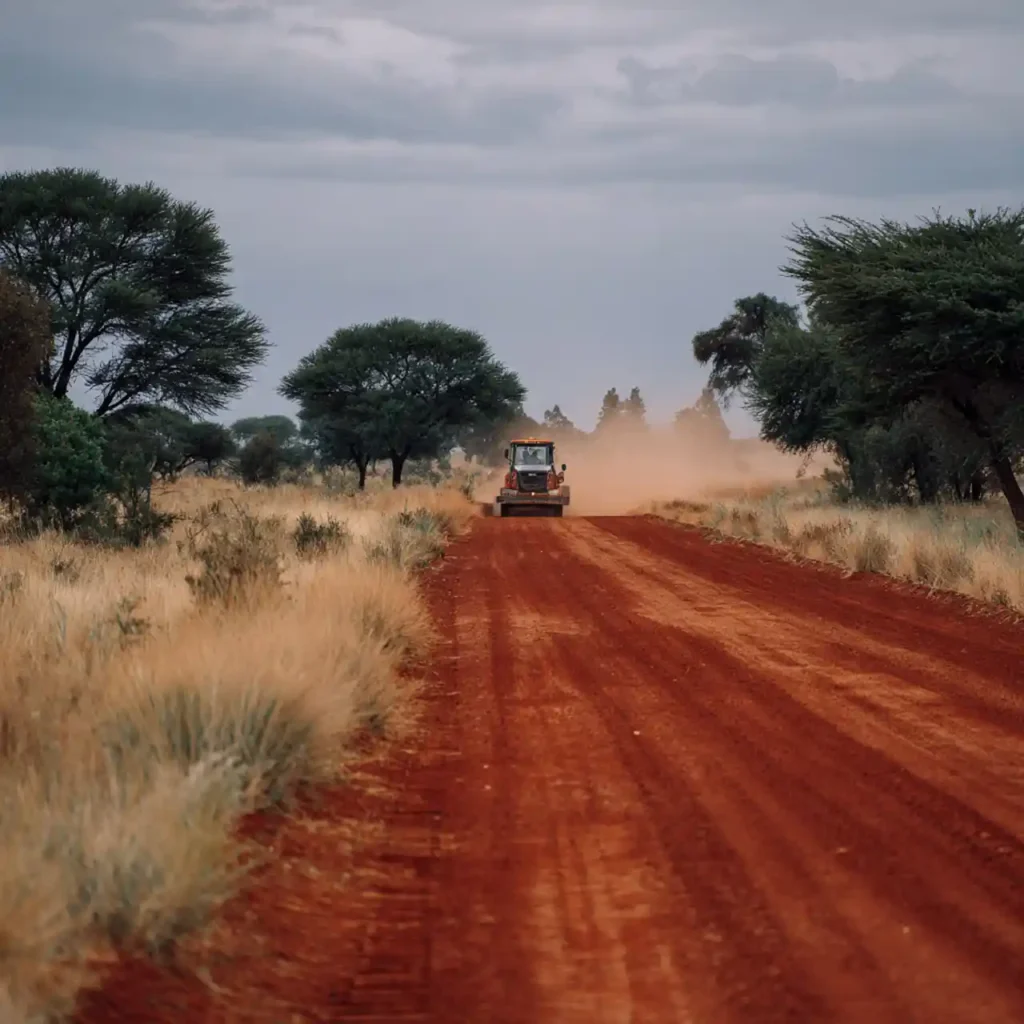
The Importance of Internal Roads in Bulawayo Agricultural Estates
Private road construction in Bulawayo, Zimbabwe is a serious infrastructure investment. It requires proper planning, engineering precision, and the right construction partner. Whether you manage a residential estate, commercial property, or industrial site, a well-built road improves access, protects assets, and reduces long-term maintenance costs.
At Tusker Civils and Landscapes, we deliver end-to-end road construction solutions across Bulawayo. From initial site assessment to final surfacing, we ensure every stage meets professional civil engineering standards suited to Zimbabwe’s climate and soil conditions.
Why Private Road Construction Matters in Bulawayo, Zimbabwe
In many cases, property owners underestimate how complex road construction really is. A road is not simply gravel or tar placed on top of soil. Instead, it is a structured system designed to carry loads, manage water, and resist long-term wear.
In Bulawayo, these challenges become even more serious due to heavy seasonal rainfall and reactive soils. As a result, poorly built roads deteriorate quickly, especially when drainage and compaction are ignored.
For this reason, Tusker Civils and Landscapes applies full engineering standards on every project, whether it is a private estate road or an industrial access route. You can explore our services here:
Step 1: Site Assessment and Road Design
Before any construction begins, we conduct a detailed site evaluation. During this stage, we assess soil type, slope, drainage direction, and expected traffic load.
Once that is complete, we design the road structure accordingly. For example, roads carrying heavy trucks require deeper base layers compared to light residential access roads. In addition, we study water flow patterns to prevent future erosion.
Afterwards, we define the road width, alignment, camber, and structural layers. Consequently, clients receive an accurate and transparent quotation based on real site conditions rather than estimates.
Step 2: Clearing and Earthworks
Once approvals are in place, we begin clearing the site. Vegetation, topsoil, and unsuitable material are removed to prepare a stable road formation.
Next, we carry out cut-and-fill operations to achieve correct levels and gradients. Proper cambering is introduced so that rainwater drains away from the road surface instead of pooling.
At this point, earthworks are also coordinated with broader site development projects where required. For example, many clients combine roadworks with landscaping or driveway construction:
Step 3: Sub-Base Preparation and Compaction
The sub-base is the foundation of the entire road structure. Therefore, it must be constructed with strict precision.
We install crushed stone or gravel in controlled layers and compact each layer using vibratory rollers. After each pass, we test compaction levels before proceeding.
Importantly, the required depth depends on traffic usage. Light roads may require around 150mm, while heavy-duty roads often exceed 250mm.
Because poor compaction leads to early failure, we enforce strict quality control throughout this stage.
Step 4: Stormwater Drainage and Kerbing
Before surfacing begins, we install a complete drainage system. This includes kerbs, culverts, catch pits, and channels designed to control water flow.
Kerbs play a key role by protecting road edges and guiding runoff into drainage points. Similarly, catch pits prevent water accumulation at low points.
According to the U.S. Federal Highway Administration, proper drainage significantly extends pavement lifespan:
Without effective drainage, even high-quality roads will fail prematurely. For this reason, we integrate stormwater systems into every project from the start.
Step 5: Base Course and Road Surfacing
After drainage and compaction are complete, we install the base course. This layer strengthens the structure and prepares it for final surfacing.
Following this, we apply the wearing course depending on project requirements:
To begin with, tar or asphalt surfacing offers high durability and a smooth finish. It performs well under heavy traffic and is commonly used in estates and commercial roads.
Alternatively, block paving provides both strength and aesthetic appeal, making it ideal for courtyards and entrance roads.
Meanwhile, gravel roads remain a practical option for farms and rural access routes where flexibility and easy maintenance are preferred.
Step 6: Line Markings and Finishing Works
Once surfacing is complete, we apply finishing elements such as road markings, signage, and speed control features.
These additions improve safety and traffic organisation, particularly in estates and shared-access developments. In many cases, they are also required for compliance and operational efficiency.
Furthermore, clear markings reduce accidents and improve navigation during low visibility conditions such as rain or night driving.
Step 7: Final Inspection and Project Handover
Before handover, we conduct a full inspection of the completed road. This includes checking surface quality, drainage performance, and structural integrity.
Additionally, we review any related civil works to ensure everything meets design specifications.
Finally, clients receive a fully completed and ready-to-use road system, along with maintenance guidance for long-term performance.
Why Choose Tusker Civils for Road Construction in Bulawayo, Zimbabwe
Tusker Civils and Landscapes brings extensive experience in civil construction across Bulawayo and surrounding regions. More importantly, we understand local soil behaviour, rainfall intensity, and infrastructure challenges specific to Zimbabwe.
We provide integrated services including:
Because we manage everything under one contract, clients benefit from better coordination, fewer delays, and improved accountability.
Ready to Build a Private Road in Bulawayo, Zimbabwe?
A properly constructed road is not just infrastructure — it is a long-term investment in access, safety, and property value.
So, if you are planning a project, Tusker Civils and Landscapes is ready to help. Our team provides site assessments, detailed quotations, and expert construction services tailored to your needs.
Recent Posts:
Private Road Construction in Bulawayo — A Step-by-Step Process Guide
The Top 6 Steelwork Projects That Add Serious Value to Bulawayo Properties
Steel Carports vs Wooden Carports — Which Is Better for Bulawayo Homes?