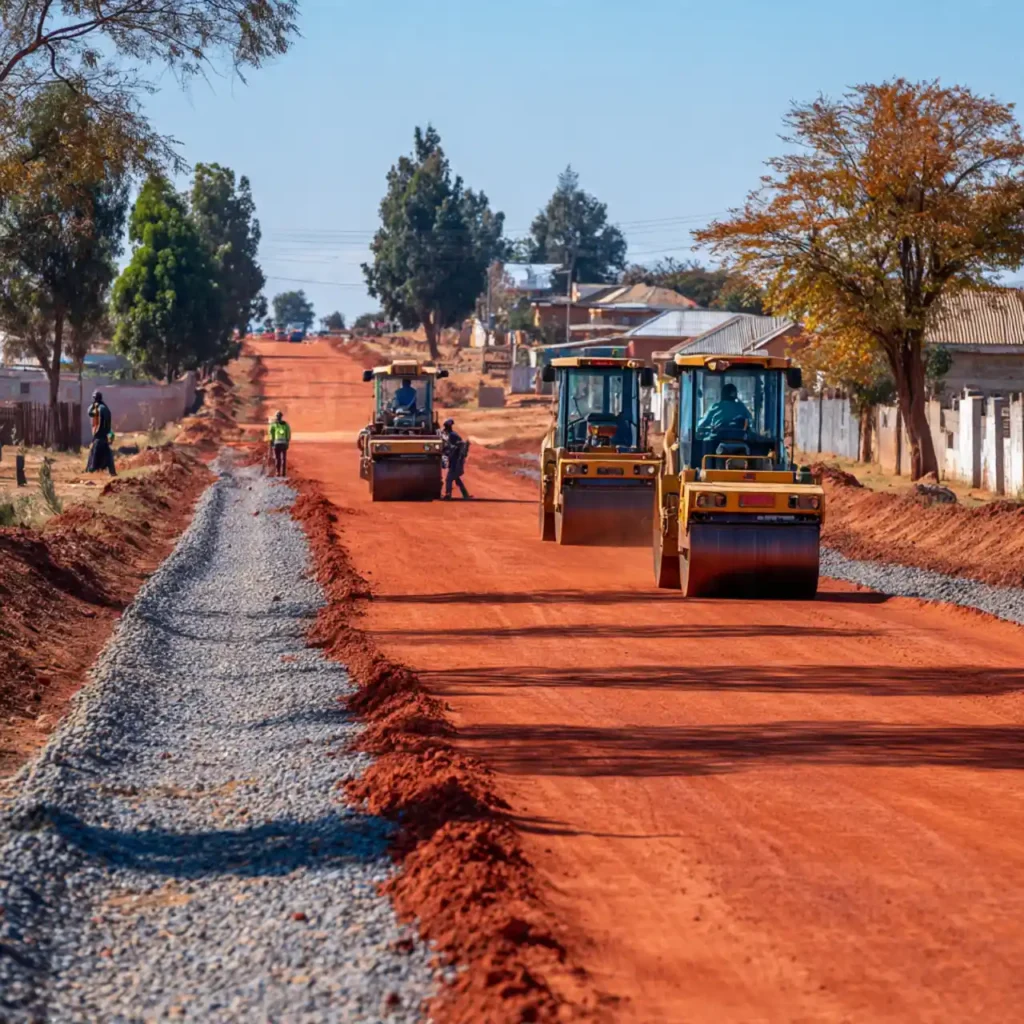
Private road construction in Bulawayo, Zimbabwe, is a significant investment — and one that demands the right contractor from day one. Whether you manage a residential estate, own a commercial property, or run an industrial facility, a properly built private road protects your assets, reduces maintenance costs, and gives every visitor or vehicle a smooth, safe surface to travel on. At Tusker Civils & Landscapes, we handle every phase of road construction in Bulawayo, from the first site assessment through to the final wearing course. This guide walks you through exactly how that process works.
Why Private Road Construction Matters in Bulawayo
Many property owners in Bulawayo underestimate the complexity of road construction. A road is far more than a layer of tar or gravel on top of soil. Without correct subgrade preparation, compaction, layerworks, and drainage, even a well-surfaced road will fail within a few seasons — especially under Zimbabwe’s heavy summer rainfall.
Private roads on residential estates, commercial plots, and industrial developments all carry different loads and face different stresses. That is why a professional approach matters. Our roadworks team in Bulawayo applies the same engineering standards to a private estate road as to a commercial hardstanding, because cutting corners at any stage leads to expensive problems later.
Step 1: Site Assessment and Road Design
Every private road construction project starts with a thorough site assessment. Before any machinery moves onto your property, our team visits the site to evaluate the terrain, existing soil conditions, gradient, drainage patterns, and intended traffic load.
This assessment directly informs the road design. For instance, a road that will carry heavy delivery trucks needs a significantly deeper sub-base than one designed purely for light vehicles. We also assess where water will flow during heavy rain, since poor drainage is one of the leading causes of road failure in Zimbabwe.
At this stage, we define the road width, alignment, camber, and surfacing specification. You receive a clear, itemised quote based on actual site conditions — not a rough estimate.
Step 2: Clearing and Earthworks
Once the design is finalised, the construction team begins clearing and bulk earthworks. This phase involves removing vegetation, topsoil, and any unsuitable material from the road corridor.
We then cut and fill the terrain to achieve the correct road level and cross-fall. Proper cambering — a slight crown in the centre of the road — directs surface water away from the road and toward the drainage channels on each side. This is critical. A road without correct camber traps water, which weakens the sub-base and accelerates deterioration.
Our earthworks division also handles site clearance for related structures where needed. If your project involves additional concrete work or hardstandings, we coordinate all of this under a single contract.
Step 3: Sub-Base Preparation and Compaction
The sub-base is the foundation of your road. Accordingly, it deserves the most attention. After earthworks, our team imports and layers selected sub-base material — typically G6 or G7 crushed stone or gravel — and compacts it in controlled lifts using a vibratory roller.
Compaction testing ensures each layer meets the required density before the next layer goes down. Skipping this step is one of the most common mistakes in low-cost road construction. Under-compacted sub-bases settle unevenly, causing cracking and surface failure long before the road reaches its design life.
The depth of the sub-base varies depending on traffic load. For light residential roads, 150mm is often sufficient. For roads carrying heavy vehicles, sub-base depths of 250mm or more may be necessary.
Step 4: Stormwater Drainage and Kerbing
Before any surface goes down, drainage infrastructure must be in place. This is a step that many property owners overlook until it is too late. Tusker installs concrete kerbing, stormwater channels, catch pits, and culverts as part of every road construction project in Bulawayo.
Kerbing defines the road edge, prevents the surfacing from breaking away at the sides, and channels water into drainage structures. Catch pits collect runoff at low points and direct it safely off the road. According to the US Federal Highway Administration, stormwater management is one of the most critical factors in road pavement longevity — a principle that applies just as strongly to private roads in Zimbabwe.
Without adequate drainage, water undermines the sub-base and causes premature failure, regardless of how well the surface was laid. We build drainage into every Tusker roadworks project from day one.
Step 5: Base Course and Road Surfacing
With the sub-base compacted and drainage in place, the team installs the base course — a stronger, denser layer that bridges the gap between the sub-base and the final surface. We then apply the wearing course, which is the layer you see and drive on.
Tusker works with several surfacing options depending on your budget, traffic load, and aesthetic requirements:
Tar/Asphalt Surfacing delivers the smoothest, most durable finish for high-traffic private roads. It handles heavy loads well and is resistant to Zimbabwe’s wet seasons when correctly designed. This is the standard choice for estate roads, commercial driveways, and industrial yards.
Block Paving suits lower-speed environments such as courtyard roads, parking areas, and entrance driveways where aesthetics matter as much as function. Our paving services in Bulawayo cover concrete block paving, clay brick paving, cobblestone, and natural stone — all engineered to the correct load specification.
Gravel and Compacted Gravel Roads suit farm access routes, rural properties, and internal estate tracks where a tar surface is not essential. We grade, layer, and compact gravel roads correctly so they remain trafficable year-round. Re-grading and re-gravelling of existing dirt roads also falls within this service.
Step 6: Line Markings, Signage, and Finishing
Once the surface is complete, we apply any line markings, road signage, and finishing details the project requires. This includes speed bumps, directional arrows, pedestrian crossings, and stop lines on larger private developments.
Road markings are not purely cosmetic. They organise traffic flow, reduce accident risk, and are a legal requirement on many private developments, particularly those used by the public. According to SaferRoads, clearly marked road surfaces significantly reduce incidents in private car parks and estate roads. We coordinate all finishing work as part of the overall contract.
Step 7: Final Inspection and Handover
Before we hand over any road, our team conducts a structured walkthrough of the completed project. We check surface finish, drainage performance, kerbing installation, and overall levels against the original design.
If your project also involved related civil work — such as waterproofing of adjacent structures, steelworks, or flooring — we inspect all deliverables together before signing off. You receive a completed project with no loose ends and a clear understanding of the maintenance schedule going forward.
What Makes Tusker Civils the Right Choice for Road Construction in Bulawayo
Tusker Civils & Landscapes brings over a decade of civil construction experience to private road projects across Bulawayo, Gweru, Harare, and Kwekwe. We understand local soil conditions, Zimbabwe’s seasonal rainfall patterns, and the specific demands of construction in this environment.
As a full-service civil contractor, we manage roadworks alongside concrete, paving, waterproofing, steelworks, and flooring — all under one contract. That means fewer subcontractors, cleaner project management, and better accountability for you as the client.
We work with residential estates, property developers, corporate clients, and private homeowners across Bulawayo’s suburbs including Famona, Hillside, Burnside, and beyond.
Ready to Build a Private Road in Bulawayo?
Do not leave your road construction to chance. Contact Tusker Civils & Landscapes today for a professional site assessment and detailed quote. Our team responds quickly, visits your site, and gives you a clear picture of costs and timelines before work begins.
Recent Posts:
The Top 6 Steelwork Projects That Add Serious Value to Bulawayo Properties
Steel Carports vs Wooden Carports — Which Is Better for Bulawayo Homes?
How Much Does Steel Fabrication Cost in Bulawayo in 2026?
How to Pour a Concrete Slab That Lasts 30 Years in Zimbabwe’s Climate