
How to Prevent Roof Leaks Before Bulawayo’s Rainy Season Starts
Every year, the pattern repeats itself across Bulawayo. The dry season stretches on for months. The sun bakes every roof in the city. Then the first real storm of the rainy season arrives, usually sometime in November. Within minutes, ceilings that were dry in October start showing damp patches. Ceiling boards sag. Buckets appear under light fittings in homes and offices all over the city. If this sounds familiar, you are not dealing with a one-off accident. You are dealing with a predictable, avoidable problem that Tusker Civils & Landscapes sees across Bulawayo every year. Understanding why it happens is the first step to stopping it before the next downpour catches you off guard.
Why Bulawayo Roofs Fail At The Start Of Every Rainy Season
Roof waterproofing in Bulawayo faces a challenge that many property owners underestimate. The city’s climate does not gently transition from dry to wet. Bulawayo spends roughly seven or eight months with almost no rain at all. Then it shifts suddenly into heavy, often torrential storms from November onward. That long dry stretch is exactly what sets the problem up.
Months Of UV Exposure Break Down Roofing Materials
Throughout the dry season, unrelenting sun beats down on roof sheeting, membranes, and sealants. There is no rain to cool them down. Ultraviolet radiation and constant thermal cycling — roofs heating up during the day and contracting at night — make waterproofing membranes, bituminous coatings, and sealants brittle. Small hairline cracks form in places you would never notice from ground level: around flashing, at parapet walls, along roof-sheet overlaps, and at pipe penetrations. None of this shows up as a leak yet, because there is no water to find the gaps. The damage stays silent, and it builds up for months before the first storm ever arrives.
Dust And Debris Block Drainage Paths
A dry Bulawayo winter also means months of dust, leaves, and windblown debris settling into gutters, downpipes, and roof valleys. Nothing washes it away until the first big storm hits. When that storm finally comes, water that should drain away in seconds instead pools against parapets. It backs up under roof sheets and finds its way through every crack the dry season created. A roof that would otherwise cope with rainfall suddenly becomes overwhelmed, simply because nobody cleared its drainage.
The First Storm Applies Sudden, Extreme Pressure
Unlike regions with a more gradual wet season build-up, Bulawayo’s opening storms tend to be intense rather than gentle. Heavy, fast rainfall puts sudden hydrostatic pressure on every weak point in a roof system at once. A membrane that might have lasted another season under light rain simply cannot withstand the volume and force of a full November thunderstorm. This is why so many leaks appear in the very first rain event of the year, rather than gradually worsening over several storms. The damage was already there, waiting for enough water pressure to expose it.
How To Stop Roof Leaks Before The Rains Arrive
The good news is that you can prevent every one of these causes with the right preparation. The ideal window to act is during the dry months, well before November. Waterproofing work, gutter clearing, and structural repairs are all far easier, faster, and cheaper on a dry roof than during an emergency call-out in the middle of a storm.
Start With A Proper Roof Inspection
The most important step is a thorough inspection before the season changes. Check membrane condition, flashing, parapet walls, roof-sheet overlaps, and every pipe or vent penetration for early signs of cracking or lifting. As Wikipedia’s overview of waterproofing explains, waterproofing a structure means making it resist water ingress under specified conditions. That resistance only holds if the membrane itself is still intact. An inspection tells you exactly where that resistance has already broken down.
Reapply Or Renew Waterproofing Membranes Before The Season Turns
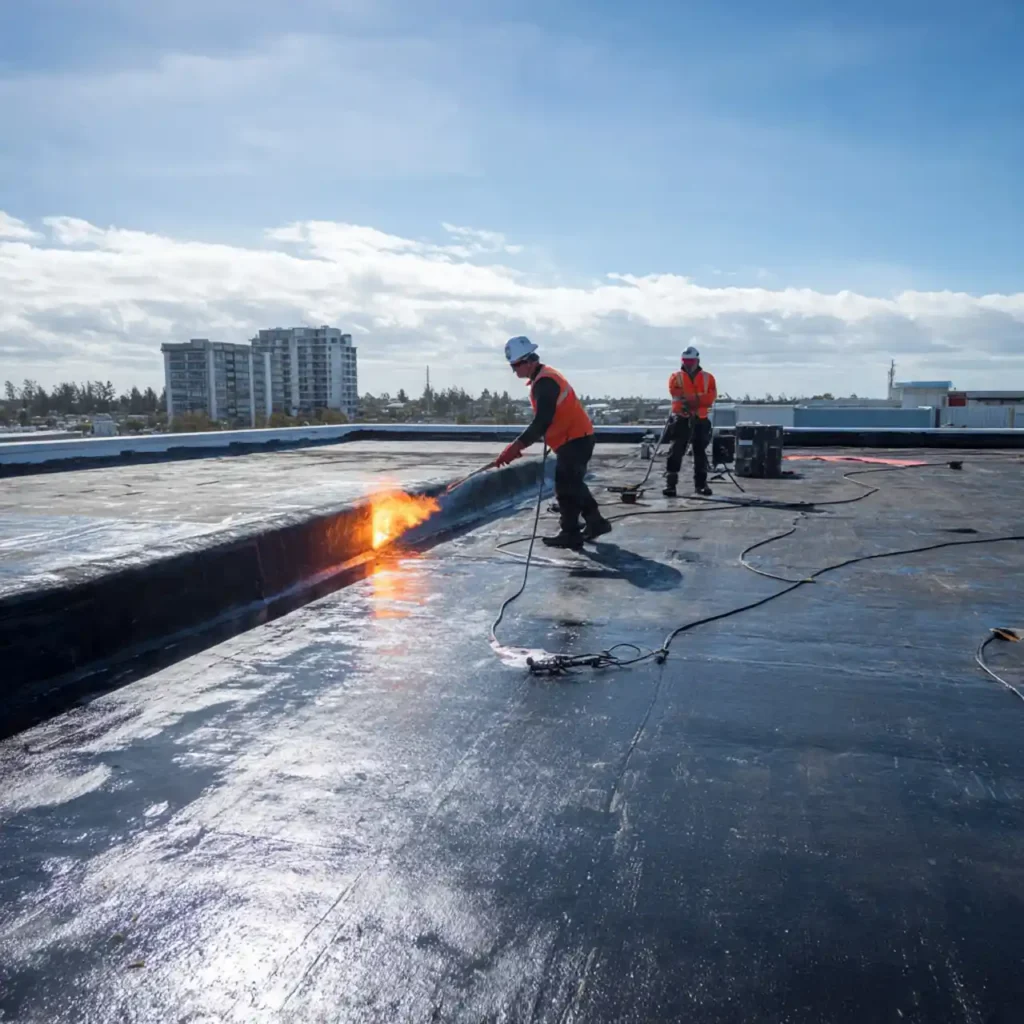
Once you identify the problem areas, the fix usually means reapplying or renewing waterproofing membranes, coatings, or sealant systems at the exact points where UV damage has occurred. This is far cheaper than waiting for a full leak to force a larger repair. Tusker Civils & Landscapes’ waterproofing service covers residential, commercial, and industrial roofs across Bulawayo, including torch-on membranes, liquid-applied coatings, and crystalline systems for concrete roofs, parapet walls, and penetrations. These are exactly the wear points a dry Bulawayo winter creates. Globally recognised waterproofing manufacturers such as Sika also stress that surface preparation and correct product selection determine whether a membrane survives its first real storm. That is exactly why a proper pre-season application matters more than a quick patch job.
Clear Gutters, Downpipes, And Roof Valleys
Dust and debris build-up is a direct cause of Bulawayo’s early-season leaks, so clearing gutters and downpipes before the rains start matters just as much as the waterproofing itself. A roof with a perfectly sound membrane can still flood a ceiling if the water has nowhere to drain and instead pools against a weak point. This is a simple, low-cost job compared with fixing water-damaged ceilings, wiring, and insulation after the fact.
Address Paving And Drainage Around The Building
Roof leaks are not always purely a roof problem. Poor ground-level drainage, cracked paving, or driveways that direct stormwater back toward a building’s foundations can make water damage worse once it gets in. Poor drainage can also contribute to damp rising through walls near ground level. Tusker’s paving and driveway services in Bulawayo use correctly compacted sub-bases and proper falls. This helps surface water move away from the building instead of pooling against it during heavy rain.
Treat Roof Waterproofing As An Annual, Not A Once-Off, Job
UV exposure and thermal cycling happen every single dry season without fail, so roof waterproofing in Bulawayo is not a one-time fix. Property owners across suburbs such as Burnside, Famona, Khumalo, Hillside, and Ilanda benefit most from an annual pre-season check, ideally completed in September or October, well ahead of the first November storm. Tusker Civils & Landscapes has built up 16 years of experience following this same inspect-and-treat approach for homeowners, estate managers, and commercial clients across Bulawayo. Tusker’s Burnside civil construction and waterproofing service puts it into practice for one of the city’s most established suburbs, under a single contract rather than juggling multiple contractors for roofing, drainage, and paving separately.
Getting Ahead Of November
The pattern of Bulawayo roofs leaking during the first big storm of the season is well understood. None of the underlying causes are mysterious once you know what to look for: months of UV damage, blocked drainage, and the sudden force of the season’s opening rains combine at exactly the wrong moment. Property owners who schedule an inspection and waterproofing top-up before the season turns consistently avoid the scramble of emergency repairs, water-damaged ceilings, and disrupted households that so many others deal with every November. If your roof has not been checked since last year’s rains, the dry season still gives you a window to act before the next storm makes the decision for you.
Latest Posts:
What is the difference between Damp Proof Membrane and Damp Proof Course?
DIY Tips for rising damp proofing in Bulawayo.
Paving Your Business Parking Lot in Bulawayo — What You Need to Know