
Herringbone Paving for Driveways in Bulawayo: Why the Pattern Outperforms the Rest
A driveway is the hardest working surface on most properties. It carries the family car every morning and takes delivery vehicles at the gate. It also endures Bulawayo’s fierce sun and summer downpours year after year. Yet many homeowners choose a paving pattern based on looks alone. That decision often shows up later as sunken bricks, open joints and standing water. At Tusker Civils and Landscapes, we treat paving as an engineering problem first and a design choice second. For most driveways and heavy-traffic areas, that thinking leads to one recommendation: herringbone. This article explains why the pattern performs so well and what it needs underneath. It also covers how it suits properties across Bulawayo and Gwanda.
What Is Herringbone Paving and Where Does It Come From?
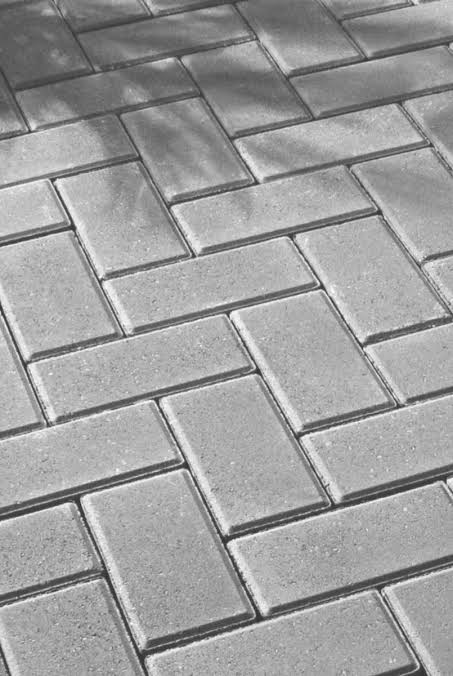
Herringbone is a paving pattern in which rectangular bricks are laid at an angle to one another, forming a continuous zigzag. The name comes from the skeletal spine of the herring fish, which the layout closely resembles. In the local trade you will often hear it called “Herrington” paving. The two names describe the same pattern, so do not let the spelling confuse your search or your quote.
The pattern is far older than modern concrete pavers. Builders have used interlocking brick layouts for roads, courtyards and market squares for centuries, and the herringbone pattern page on Wikipedia traces some of that history. It survived because it works. Each brick braces against its neighbours from several directions at once. The result is a surface that behaves as a single interlocked mass rather than a collection of loose units.
Why Herringbone Suits Driveways and Heavy Traffic
Every driveway faces two distinct kinds of force. The first is the downward weight of the vehicle, which compresses the pavers into the bedding layer. The second is horizontal stress from braking, accelerating and turning. This second force is what destroys weak paving patterns. A car turning its wheels on the spot, or a truck pulling away from a standstill, pushes the surface sideways with surprising strength.
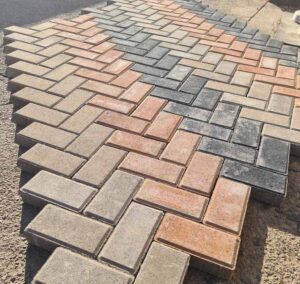
Running-bond and stack-bond layouts have joints that run in long, unbroken lines. Those lines act as natural paths for movement. Over months of traffic, pavers begin to creep along them, and gaps open at the edges. Herringbone removes those paths entirely. Every joint changes direction, so a load applied to one brick is shared with many others around it. That is why the pattern is standard in loading bays, container yards and public roads.
The practical benefits are easy to see on site. Wheel tracks resist rutting for longer, and joint sand stays compacted instead of washing out. The surface also stays flatter, which makes drainage more predictable. The Interlocking Concrete Pavement Institute publishes extensive technical guidance on interlocking pavers. Its research supports what we observe in the field: interlocking patterns carry vehicle loads better than most alternatives.
Choosing the Right Paver Thickness, Size and Colour
A good pattern cannot rescue a poor paver. For light residential driveways, a 60 mm paver is the accepted minimum. Where heavier vehicles are expected, such as delivery trucks or garden service vehicles, we move up to 80 mm. Commercial yards, depots and access roads should always use 80 mm pavers. The extra thickness costs a little more, but it is far cheaper than relaying a failed surface.
Shape matters just as much as thickness. Herringbone depends on a rectangular brick with a 2:1 length-to-width ratio. The common 200 x 100 mm paver meets that requirement exactly. Square or irregular bricks cannot lock together properly, and the pattern loses its strength.
Colour deserves careful thought in Bulawayo’s climate. Darker charcoal pavers hide oil drips and tyre marks well, which suits busy family driveways. Lighter tones reflect heat and stay noticeably cooler underfoot in summer. We always recommend viewing samples outdoors, because a colour that looks perfect in a showroom can look very different in full sun.
Why the Base Matters More Than the Pattern
The most common cause of driveway failure has nothing to do with the bricks. We regularly repair work by other contractors, and the story is nearly always the same. Pavers sink in the wheel tracks, joints open, and puddles form where none should exist. The cause lies in the layers underneath.
A proper driveway begins with excavation to the correct depth and a well-compacted sub-base. On top of this goes a bedding layer of clean, sharp sand, roughly 30 mm deep and screeded level. The pavers are then laid in pattern, cut neatly at the boundaries and compacted with a plate vibrator. Fine jointing sand is swept across the surface and vibrated down until the joints are full. Rushing any of these stages leads to trouble within a few rainy seasons.
Edge restraints are the most overlooked element. Herringbone works because the outer bricks hold the whole field under compression. If a kerb fails or shifts, the interlock is lost and the surface begins to spread. For that reason, we cast concrete edge restraints on every driveway we build.
Drainage deserves equal attention. Bulawayo’s storms can push a large volume of water across a driveway in minutes. We build in a gentle fall away from the house so that water runs off cleanly. If your driveway meets the road or a public verge, check the requirements with the Bulawayo City Council before work begins.
Herringbone Driveways in Bulawayo’s Suburbs
Bulawayo’s established suburbs are known for generous stands and long approaches to the house. These properties deserve a driveway that looks refined and lasts for decades. Herringbone delivers both and suits the character of the city’s finest neighbourhoods.
In Kumalo, older family homes sit among mature trees and traditional gardens. A herringbone driveway in warm terracotta or soft grey complements the setting beautifully. Tree roots are a real concern here, and a flexible paved surface can be lifted and relaid far more easily than a poured slab. In Hillside, many properties sit on sloping ground. Herringbone copes well with gradients when the base is properly compacted, and individual bricks can be replaced if services ever need access.
Burnside is known for larger properties with wide entrances and parking courts. Occasional heavy vehicles are common here, so we specify 80 mm pavers and reinforced edging. In Matsheumhlope, homeowners often want a driveway that matches a carefully landscaped garden. Herringbone can be combined with contrasting borders or inset panels to create a distinctive entrance. For background on the city itself, see the Bulawayo page on Wikipedia.
Every property is different. Before quoting, we visit the site, measure the area and assess the soil and slope. Only then do we recommend a design that fits your home and your budget.
Paving Projects in Gwanda and Surrounding Areas
Our work extends beyond the city limits. We also serve clients in Gwanda, where mining, transport and commercial activity place real demands on hard surfaces. Heavy vehicles are common, and the climate is harsh on exposed ground. Herringbone is well suited to these conditions. It handles concentrated loads, tolerates minor ground movement and remains easy to repair.
That last point matters for businesses. If a section is damaged by a service trench or a heavy impact, the affected pavers can simply be lifted and relaid. There is no need to break out and recast a large slab. This keeps repair costs low and downtime short. You can read more about the town on the Gwanda page on Wikipedia.
Longer-distance projects call for careful logistics. We move materials, equipment and crews together so that work starts on schedule. The standard of workmanship in Gwanda matches what we deliver in Bulawayo.
45 Degree or 90 Degree Herringbone?
Clients often ask which version to choose. The 45 degree layout is the stronger of the two, because it resists movement across the widest range of directions. For any driveway that takes regular vehicle loads, it is our first recommendation.
The 90 degree layout is slightly less resistant to movement. Its advantage lies at the edges, where it requires fewer cut bricks. That reduces waste and can lower labour time on some sites. It suits lighter residential driveways, pedestrian paths and patios well. Both versions look attractive when laid properly, and we will explain the trade-offs clearly before you decide.
Why Choose Tusker Civils and Landscapes
Tusker Civils and Landscapes combines civil construction knowledge with practical landscaping skill. We understand the structure beneath your driveway as well as the finish above it. That is why we do not cut corners on bases, drainage or edge restraints. Those details decide whether a driveway lasts five years or twenty-five.
We work across Bulawayo and surrounding areas, and we keep our process simple. You receive a clear written quote, an honest timeline and a neat, well-finished result. Many clients return once the driveway is done, asking us to extend the same quality to patios, walkways and garden walls.
Request a Quote for Your Herringbone Driveway
A herringbone driveway is a long-term investment in your property. Built on a sound base, it will serve you for decades and make a strong first impression. Contact Tusker Civils and Landscapes to book a site visit. We will assess your property, explain your options and provide a detailed quote. Whether you live in Kumalo, Hillside, Burnside, Matsheumhlope or Gwanda, we are ready to help.
Recent Posts:
- How Not to Waterproof a Metal Roof in Bulawayo: Warnings to Homeowners
- What Are The Common Causes of Leaks on Metal Roofs in Zimbabwe?
- How Much Is Roof Leak Repair In Zimbabwe For Different Types Of Roofs?
- Metal Roof Leak Waterproofing in Bulawayo: Tips To Follow
- Surface Waterproofing Vs Concrete Additives: Which Works Best?